

Triathlon All-Terrain Strategy · Trigger System
A rules-based strategy changes its allocation when a market move is confirmed, not when it first appears. The Triathlon All-Terrain Strategy (TAS) requires a move to reach a set depth, last a set number of closes and, where the rule calls for it, be supported by other readings before it reallocates.
The Triathlon All-Terrain Strategy (TAS) does not react to every market move. A change must reach the rule’s required depth, persist for the required number of closes and, where the rule calls for it, be supported by the other readings required for confirmation.
Trailing by design
Confidence builds in layers
Depth
Has the move crossed the required trailing level?
Several Dates
Has the signal persisted for the required number of closes?
Several Conditions
Where the rule calls for it, are the other required readings confirming the move?
Reallocate Risk
Once confirmation is met, the model changes the allocation and reallocates risk.
What that looks like
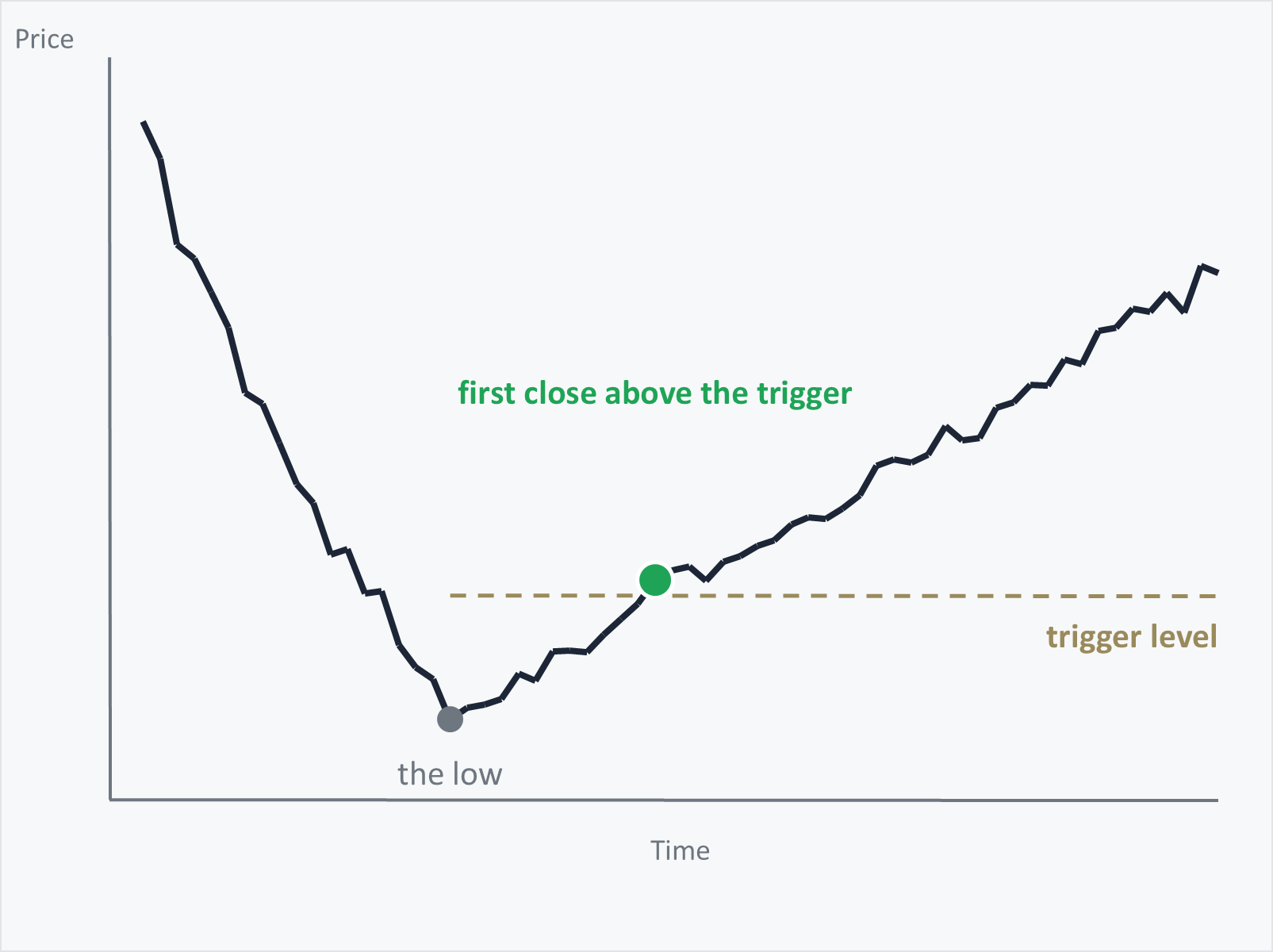
Illustrative only. Not a real market, a real trigger or a disclosed threshold.
The goal is confidence, not certainty.
Confirmation reduces the need to react to every market move, but it also means signals are intentionally late and whipsaws can still occur.
Common questions
What does it mean to confirm a market move?
In TAS, confirmation has three parts: the move has to cross a required trailing level, it has to persist for a required number of closes, and where the rule calls for it, the other readings have to agree. Only then does the allocation change.
Why are confirmed signals late?
Waiting for confirmation means acting after a move is under way, never at the exact top or bottom. That is the trade the strategy makes so that it does not react to every move. Whipsaws, where the market reverses soon after a change, can still happen.
Continue reading
← PreviousBacktested PerformanceNext →What the Model MonitorsPage 3 of 10 on the Triathlon All-Terrain Strategy.
Confirmation is described here as the combination of the depth, breadth and length of time over which triggers occur. The description is conceptual and does not disclose proprietary thresholds or show an actual trigger event. Hypothetical and back-tested, March 12, 1999 through September 30, 2026. Not actual client performance. Strategy figures are net of a 1.50% annual advisory fee. SPY and QQQ are shown with dividends reinvested and gross of advisory fees. The strategy can lose money and may underperform the market for extended periods. Past results do not guarantee future results. Historical relationships may change and are not guaranteed to persist.