

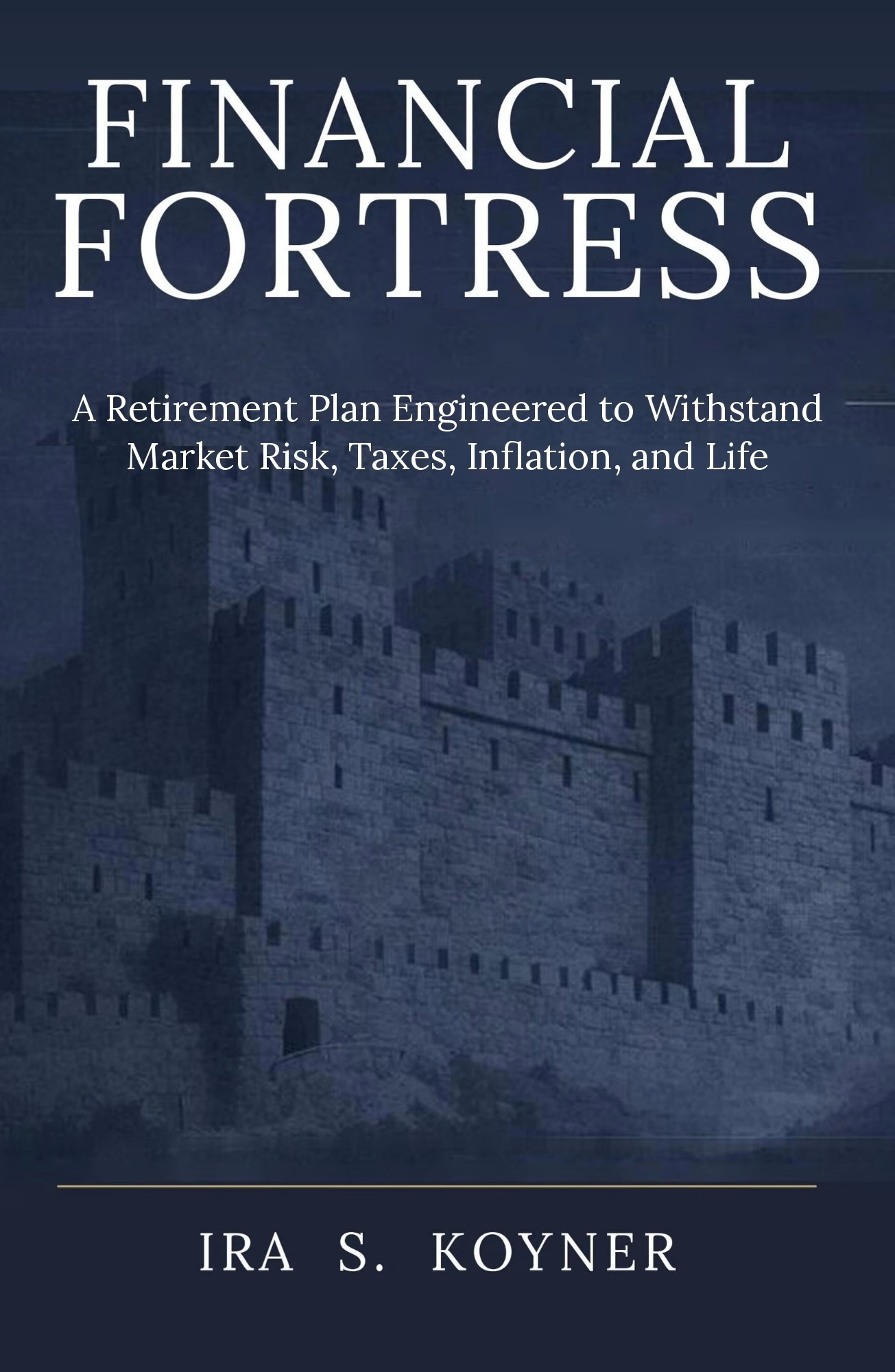
Financial Fortress
A Retirement Plan Engineered to Withstand
Market Risk, Taxes, Inflation, and Life
A fortress is not built for fair weather.
It is built for storms and siege.
Your retirement plan should be engineered the same way.
The Problem
Four forces can dismantle a retirement plan that looks sound on paper.
Most retirement plans address one or two of these risks. Few address all four. None of them announce themselves in advance. They accumulate at the seams, in the gap between decisions that each made sense in isolation and the retirement plan that never fully held together.
Volatility
A 38% market decline does not destroy a plan by itself. The damage comes from the decisions it pressures investors to make. Capital that exits near the bottom and misses the recovery does not come back.
Taxes
Tax damage builds slowly across decades of uncoordinated decisions. By the time RMDs force income, brackets compress, and IRMAA surcharges appear, the conversion windows that could have reduced the bill are closed.
Inflation
Inflation does not reduce what you have. It increases what you need. A few years of elevated prices permanently reset what retirement costs, and that reset does not reverse.
Non-Market Risks
Long-term care, disability, and premature death arrive without warning. Their costs do not negotiate with your asset allocation. Not making a decision is still a decision.
What's Inside
A coordinated retirement plan in five acts.
-
Volatility and Portfolio DesignWhy investor behavior causes more damage than market declines, and how to build a portfolio for the investor you actually are.
-
Retirement Tax Planning and Roth Conversion StrategyHow taxes compound across decades of uncoordinated decisions, and what to do before the Roth conversion window closes.
-
Inflation, Retirement Income, and TimingBuilding a retirement income system that holds through rising prices, a surviving spouse's compressed brackets, and thirty years of withdrawals.
-
The Infrastructure LayerInsurance and liquidity infrastructure that reduces tax friction, provides income when it's needed, and keeps options open when life changes.
-
Control and ContinuityEstate planning, survivor readiness, and choosing a financial advisor accountable for the whole system.
What Makes This Retirement Planning Book Different
Coordination over fragmentation.
Real numbers, real consequences
Every case study uses specific tax rates, account balances, and withdrawal sequences. Grant and Susan spent 28% more per year for decades. Big Red's coordinated plan delivered 33% more after-tax value to her heir. The math is shown, not assumed.
Built from a trading desk
Written by a financial advisor who spent nearly three decades managing institutional risk in global currency markets. Hope and prayer were not acceptable strategies on a trading floor. They are not acceptable in retirement planning either.
The whole system, not one piece
Most books cover investments or taxes or insurance. This book shows what happens when those decisions collide. The widow's penalty. The IRMAA surcharge. The Roth conversion window that closes while nobody is watching.
Honest about what does not work
The book shows when strategies fail, not just when they succeed. Dora's Roth conversion cost her money. Prudence's honest counterargument is included. Any comparison that does not show the other side is selling something.
From the Case Studies
Same assets. Same markets. Different architecture.
Grant and Susan spent 28% more per year for decades without reducing what their heirs will receive.
Minnie and Jean reduced taxes during the RMD period by 75% with an eight-year Roth conversion window that cost 22.6 cents on the dollar.
Big Red's coordinated plan delivered 33% more after-tax value to her brother from the same assets and the same spending.
Isidore built flexible infrastructure from a single annual premium that funded a business expansion, bridged a Roth conversion window, executed a partner buyout, or delivered $3.67 million tax-free to his heirs.
Prudence stayed invested through a 38% decline because the portfolio was designed for who she actually was.
Who This Book Is For
Within planning distance of retirement.
This book is for anyone who has accumulated significant assets and wants a retirement plan that is resilient through bad markets, tax surprises, rising inflation, and the transition to a surviving spouse.
If you have ever wondered whether your decisions are working together or merely coexisting, this book is for you.
If you want stock picks or a five-step checklist, read something else.
Financial Fortress covers the Roth conversion window most retirees miss, the IRMAA surcharges that silently increase Medicare costs, and the widow's penalty that can push a surviving spouse into a higher tax bracket overnight. It is a retirement plan built around coordination, not checklists. If your retirement tax planning, investment strategy, and insurance decisions have never been evaluated as a single system, this is where to start.
Ira S. Koyner managed foreign exchange options portfolios at major global banks for nearly three decades. He holds a degree from the Wharton School and is the founder of Triathlon Partners LLC, a financial advisory firm serving clients approaching and in retirement.
This book began with gaps he found in his own retirement plan. Most of the people he works with find similar gaps when they look closely. If you want to look closely at yours, he is glad to help.
Common Questions
About the book.
What is Financial Fortress about?
It treats investments, taxes, insurance, and income as one coordinated system rather than separate decisions, addressing the four forces that dismantle retirement plans: market volatility, taxes, inflation, and non-market risks. It covers Roth conversion timing, IRMAA Medicare surcharges, and the widow's penalty, using case studies with specific tax rates and account balances.
Who should read it?
People who have accumulated significant assets and are approaching or in retirement, generally within ten years of retiring, who want a resilient coordinated plan rather than stock picks or a checklist.
What is the widow's penalty?
The higher tax burden a surviving spouse can face after the first spouse dies. The survivor often files as a single taxpayer with compressed brackets while keeping much of the same income, which can raise their bracket and increase Medicare IRMAA surcharges. The book covers how coordinated planning can reduce this effect.
What is the Roth conversion window?
The period, often between leaving work and the start of required minimum distributions, when income is lower and converting traditional funds to a Roth costs less in tax. Once RMDs begin and brackets compress, the opportunity narrows. The book explains how to identify and use it.
Does anyone see the whole picture, and is anyone accountable for how the pieces interact?
If reading this book raised questions about your own retirement plan, that is a useful signal. The conversation does not have to start with a product. It starts with a look at what you have.
Read Chapter 1 Free Schedule a Planning Conversationor
Available in hardcover, paperback, and digital